Showing posts with label welfare state. Show all posts

Thursday, 10 July 2014

Here's what Yes achieves; where does No get us?


It can be infuriating as well as exhilarating  to be part of this debate we're having.  But I'm never in any doubt what side I have to be on - just a look at who backs and funds the No campaign reaffirms that.

I've written elsewhere in this blog about what I think a Yes vote immediately achieves, or leads to us achieving. Useful things, too: defending the Welfare state, defending the NHS, getting rid of Trident, renationalising the mail service. And it delivers a shock to the status quo, both here and in the rest of the UK, providing working class people with the chance to upset the neoliberal consensus.

(See these posts for a fuller discussion:

- "Will it actually make any difference to us if Scotland becomes independent?"

- "We can defend the Welfare state: we can vote Yes". ).

That's what it achieves.  What it does not achieve is a fair society and a restructuring of democracy. We do not automatically get equal access to resources, participation and decision-making for all in our society.  On the 19th September, those inequalities will still be there.  On independence day, 24th March 2016, those inequalities will still be there. Food banks will still be needed, services will still be unequal, local democracy will still be distant and unresponsive, and so on and so on.

Some Yes campaigners talk as if voting Yes solves all that in itself. It doesn't.  Yes is not a panacea; it's an opportunity to start building a better Scotland.  It starts a process.

That doesn't make it not worth doing.  It's very much worth doing.  It's a great opportunity to break the neoliberal logjam; perhaps the only such opportunity we'll have in our lifetimes.  Certainly the only such opportunity available to us now.

You might think that's obvious, so why even bring it up? Well, some people have said to me that because a Yes vote doesn't automatically bring us a fair and equal society, it isn't worth bothering with, that it's therefore a distraction.  This is a purist position I can't agree with.  We have to take what's in front of us and see what we can do with it.

To those people I say: look at what we can do immediately, and look at what we have to chance to build towards. Does voting No achieve that?  Voting No doesn't even start a process.  If No wins, then we keep WMD, we continue down the road to losing the welfare state and the NHS, the Royal Mail stays in private hands, the neoliberal project marches on uninterrupted, and we keep the institutional rightward bias of Westminster. I say it in person when I meet them, and I try to reach them through social media, to open a dialogue with them.  I don't expect one tweet to change anyone's mind, but just tweeting to the converted definitely won't.

So, I'll continue to say it: these immediate gains are worth having, so let's take them. Then let us push further and take the rest. That's what Yes achieves. Where does No get us?

Monday, 16 June 2014

10 Questions for the Pro-Union Parties on the Pledge of "More Powers".

So, the Tories, Lib-Dems and Labour have got together to make a joint-pledge on “more powers” for Holyrood if we vote No.

Campaigners
Tories, Labour and Lib Dem leaders pledging "more powers".

We have some questions for you:

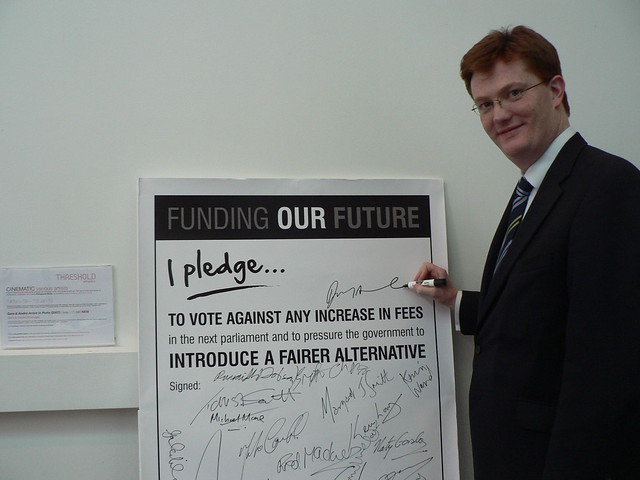
1.       Pledges are always good, aren’t they? We can remember previous Lib-Dem Pledges.  Like this one:

Lib Dem MP, Danny Alexander, signing a Pledge he and his party spectacularly broke


Why should we take this Lib-Dem Pledge seriously?

2.       You had an opportunity to get Devo Max onto the referendum ballot paper, but all three of you declined to back proposals.  What has concentrated your minds now?

3.       Never mind, you have got together now.  So, what stopped you getting your joint proposals into the Queen’s Speech? The Queen's Speech sets out the government’s agenda for the coming session, outlining proposed policies and legislation; two of you – the Tories and the Lib-Dems – are in the government.  Why were your proposed “extra powers” not in the Queen’s Speech?

4.       Could it be that you weren’t quite so worried then about losing the referendum?  That’s understandable. Oh, but, hold on, once we’ve voted No, you won’t be worried any more, will you?  How can we be sure you won’t forget your sudden joint enthusiasm?  (Don’t say “Pledge” again.  Remember, we’ve seen your Pledges before).

5.       And if you are so keen now on “extra powers”, isn’t that an admission that the UK doesn’t work very well as it stands?

6.       Even if we believe that you will deliver on this Pledge, will any of the “extra powers” get rid of nuclear weapons for us?

7.       Will any of the “extra powers” enable us to defend the Welfare State by giving Scotland power over all welfare, benefits and pensions?

8.       Will any of the “extra powers” enable us to renationalise the Royal Mail?

9.       Will any of the “extra powers” keep Scotland out of illegal wars?

10.   If “extra powers” are so great, why don’t we just go the whole hog and claim them all, rather than wait to see what we are given, if and when Westminster decides to grant them?


The fact is, we don’t really know what we’re being offered; we’d be voting for a pig in a poke.  And we don’t trust you to deliver anyway.  The only way we can be sure of getting powers that will make a difference to things we care about is to vote Yes on September 18th.  

Sunday, 9 February 2014

We Can Defend the Welfare State: We Can Vote “Yes”.

I have no great faith in politicians. They seldom live up to the hopes of the electorate, but instead spend their time and effort in protecting privilege and thwarting democracy.

When progress is made, it is usually made despite politicians, as a result of an unstoppable tide of demands they can no longer stem, at moments in which the state realises that compromise is necessary.

The Welfare State is a case in point. It was won through pressure from ordinary working people who returned from war seeking a new settlement, determined that post-war Britain would be different, and that as a result of fighting and beating fascism, they had also won the right to protection from “Want, Disease, Ignorance, Squalor and Idleness”.

The state had no option but to acquiesce to this compromise between labour and capital; the decades of struggle by ordinary working people had laid the groundwork, but the moment that those concessions were won was when the state realised that the determination of people emerging from war, whether abroad or on the Home Front, was not something they could resist.

The Welfare State is indeed an achievement to be cherished. But it is coming undone. The recent assault on it by the Coalition government, starting with Osborne’s Comprehensive Spending Review in 2010 – but which he has promised to deepen and extend – is but the latest round of attacks on that hard-won post-war settlement.

The attacks began in the 1970s, deepened under Margaret Thatcher, and were continued by Blair and Brown.

However, while both Blair and Brown showed that they could not be trusted to defend the post-war settlement, the current Conservative/Liberal Democrat Coalition has shocked with the ferocity with which it has privatised and cut. The Royal Mail was sold off at a bargain basement price; the NHS in England is being sold off bit by bit to companies that many government ministers have stakes in, and the protections that the post-war generation won for us are being dismantled.

The firestorm rages on. And yet election after election and poll after poll amply demonstrates that public opinion in Scotland does not support any of this.

Let me back up here for a moment. I’m talking about “the people of Scotland”, so what do I mean by that? I simply mean people who live in Scotland, wherever they may have been born.

But what can people who live in Scotland do to stop these attacks on the post-war settlement? For three decades and more every Westminster government – Tory, Labour, or Tories aided by Lib-Dems – has continued the assault.

However, we do have an opportunity in front of us. The independence referendum provides us with a tool that could be used to defend the welfare state in Scotland.

I am not naive enough to think that Scottish politicians area different breed. But I do think that a Yes vote will be another of those moments when politicians will be faced with the determination of the people. They will see that a Yes vote is as much a reaction against the culture of privatisation as it is anything else. They will see that the major driver behind the desire for independence is a rejection of the rightward drift of British politics. No incoming government of an independent Scotland will be able to turn back that tide.

What of those who might say that we who live in Scotland are abandoning those who live in England; that we may be defending ourselves, but what of our friends in England? Well, that is a counsel of despair; a race to the bottom. It does none of us any good to lie down together to resign ourselves all to decades more of continued state withdrawal from social welfare provision, privatisation and ever rightward drift. We can and should call a halt here. We have only ourselves to blame if we do not take this opportunity.

A Yes vote is, then, a major step in defence of ordinary working people in Scotland. But it is also something else: it is a beacon of hope for people in England, who will see that it is possible to resist the rightward advance of British politics; that the determined will of the people can win concessions; and that the post-war settlement can be defended. It is therefore not only to ourselves here in Scotland that we owe the responsibility to take this stance; to vote “Yes” and defend the welfare state. We must do it for all in these islands.