Showing posts with label indy ref. Show all posts

Sunday, 19 October 2014

Assumptions We Make About No Voters

There are assumptions that some people in the pro-independence movement are making which I think will stall the movement’s progress unless they are more closely examined.  People are projecting onto those who voted No their own motivations, but clearly No voters didn’t share all the motivations of Yes voters, or they’d have voted Yes.

If the pro-independence movement gets the motivations of No voters wrong, and keeps trying to push buttons that actually don’t work, then the achievements of the referendum will never be improved upon.

The assumptions 

First, pro-independence people assume that many No voters would have voted Yes had they only known that the No camp weren’t to be trusted on more devo powers.  Second, it is assumed that No voters are kicking themselves now that they see the NHS, for example, was not Better Together. 

How do we know? These are assumptions stemming from a pro-independence mind-set.

The Vow

I was recently speaking to some friends who had voted No, and they were quite clear that they knew the last minute devolution promises weren’t to be trusted.  That Vow played no part in their decision to vote No; they were going to vote No anyway.  For them, more devo was neither here nor there: they wanted the UK to stay united. 

Until there is better research done on people’s reasons for voting No, we can’t know how many of them are simply Unionists who want Britain to stay whole.  Why assume they were in fact duped potential independence supporters?  Why not face up to the possibility that many – perhaps all – of the 55% who voted No were simply Unionists?

The answer of course is that pro-independence supporters don’t want to believe that. It’s easier to believe that at least a proportion of that 55% were hoodwinked into casting their No votes – perhaps even enough to have given Yes a majority.

There has, after all, been a majority against independence for as long as polls have been taken on the issue, going back decades.  

Austerity, the NHS, the Welfare State

The second assumption is a little harder to unpack.  It is allied to the first in the minds of pro-independence supporters, but what about in the minds of No voters?  Does it follow that if people had been even mildly convinced that the NHS was safer with independence they’d have voted Yes?  I had assumed so, but I underestimated the weight given by many to identity because for me there is no identity reason at stake. My identity is not dependent on where a government sits. But I have talked to people who said my reasons for voting Yes were flippant and facile reasons for breaking a 300-year Union.  For me, that’s nonsense – the instrumental trumps such emotional, irrational nationalism every day.  The chance to get rid of Trident vastly outweighs attachment to the idea of government sitting in one city and not another, notions of Britishness that necessitate rule by a particular parliament, and 300 years of things having been done that way. 

And yes, that would work the other way too.  Were Scotland independent, I wouldn’t hesitate to dump that independence if I believed it meant getting rid of Trident and saving the NHS. In order to truly understand the No vote, pro-independence people need to pose themselves that thought experiment – would that apply to you, too?  Would you vote to relinquish Scottish independence if you thought there’d be instrumental benefits?  Because if you answer No to that, then perhaps you have just understood the No vote on September 18th.   How strong do the reasons for ditching your identity need to be?

Not convinced

No voters just weren’t convinced that voting Yes was best for the economy, for the NHS, or as a way to tackle austerity.  But that doesn’t necessarily mean they thought staying in the UK was bulwark against austerity.  Nor does it follow that they were just Tories and were voting for austerity.  Perhaps they hate austerity and don’t believe Westminster’s course can be altered, but neither did they think independence was a viable alternative; perhaps for them it was an additional risk, one that would be added to the problems of austerity rather than mitigating them, and therefore not a risk worth taking.  And maybe many were just Unionists anyway, and had an emotional attachment to Britain staying whole which outweighed hypothetical instrumental benefits, benefits they were neither disposed to believe, nor thought warranted breaking up the Union.  And despite the slow death of the NHS in England, most No voters are still not convinced independence would have helped.

Change You Won't Notice

I think one of the problems we had was the SNP’s strategy of change without change.  The question that that obviously begs is: if there will be no real change, why bother?

Perhaps the best example of that is the currency issue.  For most of the campaign the SNP tied itself in knots over that, and those of us outside the SNP had the difficulty of explaining a policy we didn’t support.  For me it seems obvious that to make a difference, an independent Scotland needs an independent currency and its own central bank, albeit one without interest rate setting powers – that function must be retained by government. We wanted to make a difference, didn’t we?

Tipping Point


We were asking people to overcome an emotional attachment to Britain for something that we were saying wouldn’t change that much; change you won’t notice. Despite that strong attachment to the UK - which we underestimated - there is still going to be a tipping point where that emotional attachment is outweighed by compelling instrumental reasons to break away.  In the event, it seems that many decided what was on offer wasn’t worth the trouble.  Ironically, seeking to portray the change as minimal was in fact a high risk strategy.  It ran the risk of people not seeing the point, and in the event, not enough did.

Monday, 16 June 2014

10 Questions for the Pro-Union Parties on the Pledge of "More Powers".

So, the Tories, Lib-Dems and Labour have got together to make a joint-pledge on “more powers” for Holyrood if we vote No.

Campaigners
Tories, Labour and Lib Dem leaders pledging "more powers".

We have some questions for you:

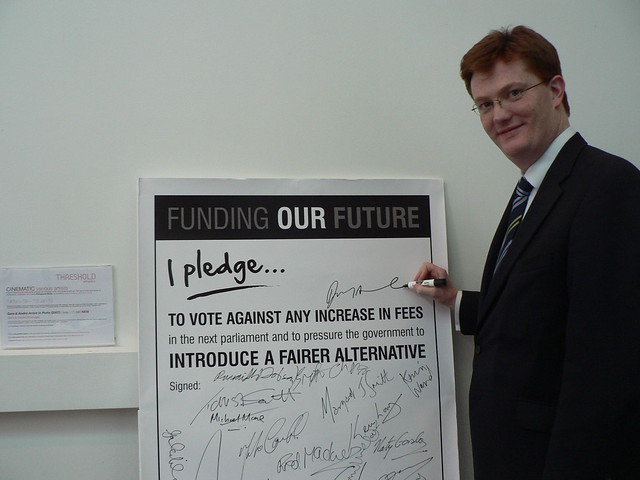
1.       Pledges are always good, aren’t they? We can remember previous Lib-Dem Pledges.  Like this one:

Lib Dem MP, Danny Alexander, signing a Pledge he and his party spectacularly broke


Why should we take this Lib-Dem Pledge seriously?

2.       You had an opportunity to get Devo Max onto the referendum ballot paper, but all three of you declined to back proposals.  What has concentrated your minds now?

3.       Never mind, you have got together now.  So, what stopped you getting your joint proposals into the Queen’s Speech? The Queen's Speech sets out the government’s agenda for the coming session, outlining proposed policies and legislation; two of you – the Tories and the Lib-Dems – are in the government.  Why were your proposed “extra powers” not in the Queen’s Speech?

4.       Could it be that you weren’t quite so worried then about losing the referendum?  That’s understandable. Oh, but, hold on, once we’ve voted No, you won’t be worried any more, will you?  How can we be sure you won’t forget your sudden joint enthusiasm?  (Don’t say “Pledge” again.  Remember, we’ve seen your Pledges before).

5.       And if you are so keen now on “extra powers”, isn’t that an admission that the UK doesn’t work very well as it stands?

6.       Even if we believe that you will deliver on this Pledge, will any of the “extra powers” get rid of nuclear weapons for us?

7.       Will any of the “extra powers” enable us to defend the Welfare State by giving Scotland power over all welfare, benefits and pensions?

8.       Will any of the “extra powers” enable us to renationalise the Royal Mail?

9.       Will any of the “extra powers” keep Scotland out of illegal wars?

10.   If “extra powers” are so great, why don’t we just go the whole hog and claim them all, rather than wait to see what we are given, if and when Westminster decides to grant them?


The fact is, we don’t really know what we’re being offered; we’d be voting for a pig in a poke.  And we don’t trust you to deliver anyway.  The only way we can be sure of getting powers that will make a difference to things we care about is to vote Yes on September 18th.  

Tuesday, 8 April 2014

ARE SCOTS “NATURALLY” LEFT WING, (AND THE ENGLISH NOT)?

It’s sometimes said that Scots are more naturally “left wing” than voters in England. It’s widely believed, but it is nevertheless a myth. However, exploring the reasons the myth arose is a good way of understanding why it is that the Westminster system is dysfunctional, and why the Union is broken.

First let’s put to bed the idea that Scots are “naturally” left wing. If that were the case, why did a majority of Scots (50.1%) vote Tory in 1955 (returning 36 Conservative and Scottish Unionist Party MPs to Labour’s 34)? That is an outright majority of the popular vote, not just the largest party.

The party of Scotland

It’s true that in that same year the Conservatives won an outright majority of the popular vote in England, but in that same year in Wales an outright majority voted for Labour (57.6%), something that has never happened in Scotland. That’s right: Labour has never had an outright majority of the popular vote in Scotland. It wasn’t until 1964 that Labour began to overtake the Conservative and Unionists in Scotland in terms of share of the vote. In that year, though, the Conservatives still managed 40.6% of the Scottish vote, compared with 44% in England.

So what happened? Why the apparent divergence between Scotland and England that we see today?

Well, first of all it is worth remembering that just as Labour has never had an outright majority of the popular vote in Scotland, so the Tories never had an outright majority of the popular vote in England after that 1955 general election. Thatcher never once had a majority of the popular vote in England. In each of her general elections, a majority of English voters voted against her party.

True, the Tory percentages in England during the Thatcher era were in the 40s, while in Scotland they began at 31.4% in 1979, and began to slip into the 20s. But even in 1992, more than a quarter of Scots were still voting Tory. (By 2010, it was only 16.7%).

The Tories have never had a majority in England in more than 50 years

However, hold onto one salient point here: in more than half a century, the Tories have never managed more than half of the votes cast either in the UK as a whole or in England alone.

First Past the Post

The reason that they have had government majorities (that is, a majority of seats in Westminster, as opposed to a majority of votes) is the first past the post electoral system (FPTP). It’s seats that count, not votes. There are a huge number of seats in Westminster that are safe seats. It’s around 400, give or take, depending on various factors. They tend not to change hands. And even then, some don’t “matter” as their MP will not form part of a government majority (eg SNP seats). In 2010 there were 650 constituencies, but only upwards of 150 seats – 23% of seats or so – were “marginal”. The average Westminster seat has not changed hands since the 1960s; fewer than one-in-ten seats has changed hands in 12 of the last 17 general elections since 1950. Furthermore, marginal seats are not evenly spread. I don’t want to get into the complicated algorithms, but there are more marginal seats in the South of England than there are total seats in Scotland. It is in the handful of marginal seats that Westminster elections are really fought.

It is thought that there will be around 190 marginal seats in the 2015 general election; 29% of constituencies. Nor are all of these as hotly contested, with only a tiny proportion seeing the highest campaign spending, usually in three-way marginals.

Nor is that the end of the matter. Within each constituency in that handful, only a small margin separates the first placed party from the second placed. And it is influencing those margins that Westminster politics tailors itself towards.

Keeping the centre-right orthodoxy

The majority of seats can be relied upon, so the policies are tailored towards placating those swing voters in that handful of marginal seats. Traditional Westminster wisdom holds that these represent “Middle England”, and all three Westminster parties calibrate their policies towards not offending them. The media, especially press, but also broadcast, plays its part in perpetuating this traditional, individualist, centre-right “common sense” orthodoxy. The New Labour phenomenon was built on that. As is Miliband’s promise to ape Tory austerity ideology.

However, although no party will step out of line for fear of losing those swing voters, the funding of big business, or being called “loony” by the press, the majority British public - including the majority of Conservative voters – hold very different views to those of the parties. The vast majority of the British public, including English voters, wants the NHS to stay in public ownership. They also support re-nationalising the energy and rail companies, and they opposed the sale of Royal Mail. However, there is no party with a chance of winning offering those policies that English voters can vote for. There is a democratic deficit in England as well.

People of England not out of Step with Scots

The people of England are not so out of step with the people of Scotland. It is the Westminster political classes that are out of step with the people. There is a perfect storm of inter-party ideological homogeny, business funding, media manufacture of consent, and neoliberal consensus in the ruling classes. The UK public has no choice at elections but neoliberal a, b or c. The parties are all vehicles of the neoliberal project.

This is an important point for two reasons: first it exonerates the British public: whichever party they vote for is “right wing”; secondly, it begs the question of how accurately we can describe Scottish votes as being for “left wing” parties. In the 2005 Westminster general election, for example, 39.5% of Scottish votes cast were cast for Labour.

How left wing is Labour anyway?

However, by what measure was Tony Blair’s Labour government “left wing”? It was a government that had two years previously led us into an illegal war in Iraq, along with the US. Blair had an easy alliance not just with George W Bush, but also with Berlusconi and Aznar. Blair preached across Europe about selling off public services. The Blair government accelerated the demonization of the disabled, the poor, and the unemployed, not least with the rhetoric around welfare-to-work. Labour in government spent 13 years consolidating Toryism. So that 39.5% was not cast for a left wing party. Nor were the 22.6% of votes that Scottish voters cast for the Liberal Democrats. Already that is more than 62% of votes cast for non left wing parties, and we haven’t yet added the Scottish Tory vote, or dissected the policies of the SNP.

So, this idea that Scots were voting for left wing parties is looking a bit shaky. However, the same mitigation applies: what were the choices on offer?

That the choices in a parliamentary democracy are limited ought not to surprise us. As one of America’s Founding Fathers, John Jay – head of the Constitutional Convention and the first Chief Justice of the Supreme Court - used to say, “The people who own the country ought to govern it” (quoted in Chomsky, Understanding Power, 2002, p315). The purpose of government is not therefore to represent the interests of the working class, but of the owning class. That is why choice in elections is limited to a narrow band of “acceptable” opinion in the US, as it is in Westminster.

No wonder, then, that Howard Zinn said of voting that it was “a poor substitute for democracy, which requires direct action by concerned citizens”.

So why bother?

Why, then, should we hope for better in an independent Scotland? Well, first of all, the 19th of September is not the end of a process, but the beginning of one. It must be the beginning of a process where we seek out and understand the self-activity of the people, and articulate it in ways which contribute to community empowerment. We will also be dealing with a government of a much smaller state, with the levers of power therefore closer to the people. And it will provide us with the opportunity to force our political leaders to listen to us, to respect the social democratic consensus that is bringing them to government, and understand that a new consensus is being demanded. (I have talked about this at greater length in another blog post). We have, in short, a rare opportunity to break that Westminster neoliberal log jam, not just for ourselves, but for our English neighbours. If we pass up this opportunity, then we condemn both Scottish and English working people to continue in the same faux democracy, with the illusion of choice, and the interests of the owning class thrust upon us by the Westminster charade.

http://yougov.co.uk/news/2013/11/04/nationalise-energy-and-rail-companies-say-public/

http://www.parliament.uk/documents/commons/lib/research/rp2003/rp03-059.pdf

http://www.electoral-reform.org.uk/images/dynamicImages/file/ERS_Penny%20for%20your%20vote_Final.pdf

Tuesday, 18 March 2014

Culture, Identity and the Non-nationalist Case for Independence

At the weekend, I was speaking to a friend at a party. She raised the independence referendum (as is now normal at social gatherings, chance meetings, barbers shops and bus stops), and expressed concern as an undecided voter that there were anti-English bigots who supported Yes.

I pointed out that there were anti-English bigots supporting No, too. That, sadly, bigotry will exist whether Yes wins or No wins. But she was unconvinced.

She also said that although she was worried that a Yes vote would unleash further anti-English bigotry, she was a “proud Scot”. I asked her what she meant by “proud Scot”. For me, that’s an alien concept. I find it very odd that you can have pride in something that isn’t an achievement.

What is it to be a Scot? Surely some combination of the following: you were born in Scotland; you live in Scotland and wish to self-identify as a Scot (whether or not you were born there); or you come from a Scottish background, although you live elsewhere.

So what is Scotland?

Well, it is not one homogenous culture. Few nations if any have but one homogenous culture. Nor does culture, in Scotland or almost anywhere else I can think of, coincide exactly with national boundaries.

Nations generally house many cultures, some of which overlap each other. Cultures also overlap national boundaries. I was brought up in Highland Perthshire by a mother from the Borders and a father from the Lanarkshire coal fields. I didn’t speak Doric or eat skirlie, like folk from Aberdeenshire. I didn’t speak Shetlandic or eat reested mutton. Born in the mid 60s, the music I liked in my teens set me apart from my parents. The music I listen to now is probably alien to most teens today.

Both sides of my family came to Scotland from Ireland in the 19th Century. Maybe yours did too; or from Italy, or the Asian Subcontinent, or from England. These ingredients and more shape our personal cultural experiences.

Culture is part of what it is to be human. Indeed, the rudiments of culture have been found in other social animals. We humans cannot exist outside of culture. It is nonsense therefore to feel proud to belong to a particular culture – if you didn’t belong to one culture, you’d belong to another. If you are proud of your culture, what are you saying? That you’re glad you don’t belong to another? I can’t follow you down that road, I’m afraid.

That’s not to say culture is not important; of course it is. It enriches our lives and binds our communities. What it does not do is neatly coincide with national boundaries.

That’s because national boundaries are arbitrary; they are administrative boundaries, they demark polities. They are bureaucratic divisions.

If you live in Stirling would it make any difference to your own culture if the Scottish border was redrawn 50 yards south of where it lies now? 2 miles? 10? 47? Or north by those degrees? All that would happen is that others, with their communities and cultures, would be added to or subtracted from the nation. You would continue to speak Scots or not. Understand Gaelic or not. Eat black bun or not.

Furthermore, Scotland remains a polity within the British Isles. It is a geographic fact, and it is a cultural fact. I will continue to watch Coronation Street. I will buy the next Fall album (and continue to call it an LP, unlike my children). I will visit the inlaws in England on holidays and high days, several times a year. None of this would change because of independence. My support for Scottish independence is not based on any notion of cultural identity. Nor have I met anyone for whom that is the main motivation. The demand for independence is not about identity.

The reasons people generally give for voting Yes are political, democratic, instrumental; tactical even. They want rid of Trident. They want rid of austerity ideology. They want to give neoliberalism the boot. They want the government they voted for, not another imposed upon them. They want to build a new social democratic consensus. Those are the sorts of reasons people give me when they tell me they are voting Yes, rather than to do with identity. By contrast, many of those who say they will vote No tell me it is because they “feel” British, rather than for any political or instrumental reason. A vote for the Union is, in my experience, more often for reasons of identity.

I concede that this is anecdotal. However, I can’t find polling evidence for a link between national identity and reasons for voting choice. Opinion polls have looked into national identity and voting intentions. But they have only sought to compare identity with voting intention, not with their reasons for voting the way they intend to vote.

I believe that by recognising that culture and nation are not synonyms we can build an inclusive Scotland where all our cultures are valued. It is only by trying to equate culture and nation that we would exclude.

Furthermore, we must not fall into the trap of thinking that freedom for “the nation” is the same as freedom for the individuals within the nation’s boundaries. Just as culture is not homogenous, neither are the interests within “the nation” homogenous. The interests of the corporation are not the same as interests of the individual. There is no identity of interest between CEOs and working people merely because they live in the same country. Nations are polities. It is the people within them who need to be free.

This case does not need to be made within the pro-independence movement. Irish Scots are Scots. Asian Scots are Scots. Anglo Scots are Scots. This last case might still need to be made, though, to undecided voters, and to those unsure of where the demand for independence comes from. That, and that we would continue to value our cultural interaction with others in these islands.

If the people of Scotland vote Yes on 18th September, that is not the end of the matter. It is but the beginning of the road to self management. But it is a road that people of all the various and overlapping cultures in Scotland can take together. There are still people to be convinced of this.

Thursday, 13 February 2014

The BBC headlines and the Currency Shenanigans

The BBC is getting it all wrong again. To the extent of misrepresentation. The headline they have is:

Independence vote: 'Yes' means no Scottish pound, says Osborne
http://www.bbc.co.uk/news/uk-scotland-scotland-politics-26166794

No it doesn't.

1. First of all, an independent Scottish currency could be called the Pound, after all that's what it was called before 1707. Several countries call their currency the Pound. Ireland did from 1928 until they joined the Euro, changing over to Euro coins and notes in 2002. (Irish pound in English, Punt Éireannach in Irish).

Were Scotland to opt for a separate currency it would probably be called the Scottish Pound (in English), or Pund Scots (in Scots). So if Osborne gets his way, that means there would be a Scottish pound. (It's only if he doesn't that there wouldn't).

2. Even if the headline means Pound Sterling, it is still wrong. Scotland could use Sterling without formal currency union, all that would mean is that the Bank of England would not be the lender of last resort, and there would be no financial or fiscal regulation by the central bank.

3. What Osborne is actually saying is that he will veto formal currency union, effectively he will not let Scotland use the Bank of England as a lender of last resort.

4. Several commentators (including former Scottish Labour leader Henry McLeish) don't believe him anyway: there are good reasons he would reverse that post Yes. The SNP certainly says it thinks he will change his mind if there is a Yes vote.

From that BBC link:

Labour's former Scottish First Minister Henry McLeish criticised the intervention by the three pro-union parties, and said Scots "shouldn't be fooled" by the suggestion that a currency union could not be worked out.

He told BBC Scotland: "This is entirely political and of course consistent with the unionist campaign. This is negative, it is about spreading fears and scare stories.

"What we require from the unionist parties is a bit of statesmanship and quite frankly their behaviour so far falls well short of that."

Iain Macwhirter, in the Herald, says that the Bank of England "doesn't want a separate currency in Scotland undermining the UK balance of payments". The Bank of England Governor, Mark Carney, made it quite clear he would make currency union work if that's what both parties wanted.


So, BBC, please aim for more accuracy in your headlines and reporting.

UPDATE: the headline has now been changed to the more accurate "Yes vote 'means no money union'". Good. Missed the morning rush, though.

Tuesday, 11 February 2014

Cameron's Stay Speech: Ted and Dougal, or cynical Eurosong boss?

By now, you’ll have seen David Cameron’s Please Stay, Scotland, speech.


It seems so obviously counterproductive to many people that I've heard at least twice independently since Friday the theory that Cameron's actual intention was to drive people into the Yes camp. The theory goes that the Tories want to increase their chances of a majority at Westminster but have to be seen to be trying to save the Union.

It's like the Father Ted episode, "A Song for Europe". Cameron's speech is the equivalent of My Lovely Horse, original non-plagiarised version.


Surely, Cameron knew how it would play? Or did he?

So the speech might be My Lovely Horse, but the thing we need to know is this: do we have David Cameron in the role of the cynical Irish Eurosong boss, Charles Hedges, who is trying to throw the competition so that Ireland doesn’t have the expense of hosting the competition, or is he the self-unaware Ted and Dougal, caught up in Eurosong fever, who actually think they can win?

Which would you rather the prime minister was?


Tories, nil points.
Tories, nada.
Tories, keine Punkte.
Tories, nurda proken.
Tories, nil punten.
Tories, nurda purda.
Tories, niet puntalete.

Sunday, 9 February 2014

We Can Defend the Welfare State: We Can Vote “Yes”.

I have no great faith in politicians. They seldom live up to the hopes of the electorate, but instead spend their time and effort in protecting privilege and thwarting democracy.

When progress is made, it is usually made despite politicians, as a result of an unstoppable tide of demands they can no longer stem, at moments in which the state realises that compromise is necessary.

The Welfare State is a case in point. It was won through pressure from ordinary working people who returned from war seeking a new settlement, determined that post-war Britain would be different, and that as a result of fighting and beating fascism, they had also won the right to protection from “Want, Disease, Ignorance, Squalor and Idleness”.

The state had no option but to acquiesce to this compromise between labour and capital; the decades of struggle by ordinary working people had laid the groundwork, but the moment that those concessions were won was when the state realised that the determination of people emerging from war, whether abroad or on the Home Front, was not something they could resist.

The Welfare State is indeed an achievement to be cherished. But it is coming undone. The recent assault on it by the Coalition government, starting with Osborne’s Comprehensive Spending Review in 2010 – but which he has promised to deepen and extend – is but the latest round of attacks on that hard-won post-war settlement.

The attacks began in the 1970s, deepened under Margaret Thatcher, and were continued by Blair and Brown.

However, while both Blair and Brown showed that they could not be trusted to defend the post-war settlement, the current Conservative/Liberal Democrat Coalition has shocked with the ferocity with which it has privatised and cut. The Royal Mail was sold off at a bargain basement price; the NHS in England is being sold off bit by bit to companies that many government ministers have stakes in, and the protections that the post-war generation won for us are being dismantled.

The firestorm rages on. And yet election after election and poll after poll amply demonstrates that public opinion in Scotland does not support any of this.

Let me back up here for a moment. I’m talking about “the people of Scotland”, so what do I mean by that? I simply mean people who live in Scotland, wherever they may have been born.

But what can people who live in Scotland do to stop these attacks on the post-war settlement? For three decades and more every Westminster government – Tory, Labour, or Tories aided by Lib-Dems – has continued the assault.

However, we do have an opportunity in front of us. The independence referendum provides us with a tool that could be used to defend the welfare state in Scotland.

I am not naive enough to think that Scottish politicians area different breed. But I do think that a Yes vote will be another of those moments when politicians will be faced with the determination of the people. They will see that a Yes vote is as much a reaction against the culture of privatisation as it is anything else. They will see that the major driver behind the desire for independence is a rejection of the rightward drift of British politics. No incoming government of an independent Scotland will be able to turn back that tide.

What of those who might say that we who live in Scotland are abandoning those who live in England; that we may be defending ourselves, but what of our friends in England? Well, that is a counsel of despair; a race to the bottom. It does none of us any good to lie down together to resign ourselves all to decades more of continued state withdrawal from social welfare provision, privatisation and ever rightward drift. We can and should call a halt here. We have only ourselves to blame if we do not take this opportunity.

A Yes vote is, then, a major step in defence of ordinary working people in Scotland. But it is also something else: it is a beacon of hope for people in England, who will see that it is possible to resist the rightward advance of British politics; that the determined will of the people can win concessions; and that the post-war settlement can be defended. It is therefore not only to ourselves here in Scotland that we owe the responsibility to take this stance; to vote “Yes” and defend the welfare state. We must do it for all in these islands.