Wednesday, 11 March 2015

Philip Hammond and the "responsibility of apologists".

Philip Hammond, Secretary of State for Foreign and Commonwealth Affairs, was widely reported yesterday to have told a meeting of the defence and security think tank, the Royal United Services Institute, that "apologists" for those who commit acts of terrorism are partly responsible for the violence.

His words, in context, were:

"We are absolutely clear; the responsibility for acts of terror rests with those who commit them.

"But a huge burden of responsibility also lies with those who act as apologists for them."

We should be wary of this line of thinking for three reasons.

First, it continues to propagate the superficial and facile account of how “radicalisation” occurs, an account that does nothing to tackle the reasons that some people are attracted to Islamism and other terrorist creeds; secondly it raises the notion of restricting what the state will allow people to say, while being vague, yet again, about what constitutes being an apologist; and thirdly it seeks to widen the definition of “responsibility”.

How is being an apologist to be defined?  And who does the defining?

Definitions are important. It is quite easy, for example, to be accused of defending views you actually despise simply by opposing state intervention against those who utter the views. And which acts of barbarism are to be beyond the pale?  I consider the Israeli state’s actions in Gaza to be a reign of terror; will those who support the Israeli state be considered by Hammond to share the burden of responsibility for that violence? It seems unlikely.

But what of acts that attract wide consensus: don’t we all agree that ISIS are bloodthirsty murderers? Well, I certainly do, but we need to examine more closely what Hammond might mean by saying someone is an apologist for those types of acts.

A recent poll of 1000 Muslims in Britain got a lot ofcoverage. It was a Com Res survey for BBC Radio 4’s Today programme.  One finding that provoked coverage was the response to the question, “do you agree or disagree with this statement?”: “I have some sympathy for the motives behind the attacks on Charlie Hebdo in Paris”.


Much of the reporting picked up on the fact that 27% said they agreed with the statement.  But look at the question more closely. It’s vague.  The possible motives were not suggested; respondents were left to guess what the motives were.  Furthermore, importantly, note that having “some sympathy with” a motive does not necessarily mean you think that the motive justifies carrying out murder. 

It was assumed in the media that this 27% approved of the Charlie Hebdo murders, but the poll does not justify that reading.  Since motives were not suggested in the question, respondents were providing their own list, many of which perhaps even I would have “some sympathy” with. I say perhaps, because I don’t know – nobody does.  The question, however, does not ask people to agree or disagree with the statement that ‘The motives justify the murders’. So we don’t know how many, if any, of that 27% thought so.

Does Hammond have these people in mind?  Does he think a “huge burden of responsibility” for the Charlie Hebdo murders “also lies with” that 27%? If he does, then he is clearly just looking for people he can pin blame on. 

Let’s say the state decides to ban people saying something even as mild as that they have “some sympathy with” what they assume to be “some of the motives behind” an atrocity.  What effect would that have?  First, it would create resentment.  Some of those assumed motives might include just grievances.  But even if some of the motives are based on intolerance and bigotry (and let’s make no bones about this, there do exist some pretty unpleasant and reprehensible ideas), criminalising their expression will not stop those ideas - they will fester and grow, and their causes will not be addressed. Secondly, the act of state repression of the ideas will give them currency and a certain “legitimacy”; merely by seeking to silence them, the state will add weight to them.  “See how they suppress our beliefs!”

The ideas will still be there.  The reasons they arose will not have been tackled (indeed, they’ll have been exacerbated).  And the net will have been cast far too wide.

Let us not forget that the definition of “domestic extremism” used by the police has been ludicrously loose, and has been used to justify surveillance of journalists and that “dangerous” Green party peer, Baroness Jones.

If they can be caught up in these loose and meaningless definitions, then so can you and I.

What, then, is Hammond’s statement all about?  It’s about selling an idea that “radicalisation” is caused by “hate speech”, and that the way to stop radicalisation is to clamp down on what people are allowed to say.  But more importantly, it’s about the state wanting to look as if it’s doing something.

So what is “radicalisation”?

According to forensic psychiatrist Marc Sageman, who has studied the issue in some depth, “The notion that there is any serious process called 'radicalisation', or indoctrination, is really a mistake. What you have is some young people acquiring some extreme ideas - but it's a similar process to acquiring any type of ideas. It often begins with discussions with a friend.”

Kenan Malik picks up the thread in his article “The Making of Wannabe Jihadis in the West”.  He writes:

“Simplistic narratives about ‘radicalisation’ miss the complex roots of homegrown terrorism. Proposed solutions, such as banning organizations, pre-censoring online hate speech, increasing state surveillance, and so on, betray our liberties without addressing the issues that has made Islamism attractive to some in the first place”.

Instead, we need to look at the processes by which people might become “disembedded from social norms”, but to recognise that the “radicalisation” notion looks at them the wrong way round.  

Malik says “the ‘radicalization’ argument looks upon the jihadists’ journey back to front. It begins with the jihadists as they are at the end of their journey – enraged about the West, and with a black and white view of Islam – and assumes that these are the reasons they have come to be as they are.”

For Malik, we need to recognise that society has become fractured, but that the issue is not that the “Muslim community” has become disengaged with wider society. The term itself encourages a misunderstanding - there is no one “Muslim community”, any more than there is a “white community”, for example; instead, we should refer to a Muslim population. No, the issue is that wider society itself is fractured and atomised, with many individuals finding themselves adrift and looking for identity and belonging, and this includes, but is not particular to, Muslims.

The way to address this is not to drive in further wedges and intensify feelings of alienation, but to engage, to challenge, to demonstrate which ideas are ridiculous, not to drive those ideas underground.


But then maybe just saying all this makes me an apologist in some people’s eyes.

Thursday, 5 March 2015

The ID Database Hasn't Been Thought Through.

It’s been interesting to see the reaction of SNP supporters to criticism of what is officially called the “proposed amendments to the National Health Service Central Register”. Not least because the SNP itself is officially opposed to an ID database; its stated concerns include some of my concerns.

Here’s an SNP press release from 2009: http://www.snp.org/media-centre/news/2009/feb/snp-confirm-scottish-id-card-opposition

So where are these current proposals coming from? They originated when Labour was in office in Holyrood, but come from the Scottish civil service. It should be no surprise that many projects originating from the civil service continue no matter which party is in power.

That being the case, why are SNP supporters so keen to defend the plans?

It seems that many believe that it must be OK if the SNP is doing it. Well, that kind of faith is touching, but I’m unable to share it. SNP supporters need to ask themselves if they are completely comfortable that there will be no “mission creep”, bearing in mind that this proposal is being driven by civil servants. They also need to consider a future when the party they trust so much might no longer be in power: are they just as happy with someone else running this scheme?

I’ve heard some interesting views on the proposals. That it “isn’t data that’s being held, it’s your name and address”. Well, that is data. The proposal specifically says the point of the exercise is “to enable certain data contained on the National Health Service Central Register (“the NHSCR”) to be shared with certain named bodies and for the NHSCR to hold additional postcode data”. So, data given to the NHS will be shared with other bodies - up to 100 authorities and services within Scotland. The information I gave to the NHS – even just my name and address - was specifically given to the NHS to assist the NHS in dealing with me. I did not give my permission to the NHS to share that information with other bodies.

It may be that I’m less trusting about handing over my information in this data sharing age. I’m not on Facebook, for example, precisely because I have concerns about how my data would be shared. Many people are quite comfortable about a degree of data sharing. But perhaps they are too ready to see the advantages and therefore too keen to discount the possible dangers. One of the possible dangers is that systems can harbour errors. Data can be lost, corrupted, or incorrect to begin with. If those errors have only one source, against which every service or public body verifies their information, then countless problems can arise. Individuals might find themselves “non-people” because somebody has entered their name incorrectly once, and the error is repeated over several bodies.

For example, I had an issue with a bank, on their correspondence to me, issuing me with an extra middle name that I don’t possess. I noticed that they had begun doing this this several years ago, and went into the branch with my passport to prove that it wasn’t my name. They duly changed it in their records, but just recently the same erroneous middle name has crept back into their correspondence somehow. Many of you will no doubt be able to think of similar examples. So far, this particular issue has caused me no problems. Yet. But it could. And how much more so if the central registry makes such an error, and that becomes the verified “truth” against which my bone fides is checked?

A central registry is just a bad idea.

Another response I’ve seen is that this is all voluntary. “An individual will give, of their own free will, their details if they want to access a service, and this will then be checked against the central registry”.

Well, that’s not quite right, is it? The central registry will already have your details – they’ll have harvested them from details given to the NHS. And in any case this talk of checking someone’s entitlement against a central database doesn’t sit well with me at all. It doesn’t sound very voluntary; it sounds like a compulsory ID card without the card. The card itself was never the real problem anyway, it was the central register that was the problem – and here it is all over again, in a new guise.

Before you dismiss this as nothing to worry about, read the handy briefing from Open Rights Group:

https://scotland.openrightsgroup.org/policy/2015/02/19/the-scottish-national-id-database-your-questions-answered/

Wednesday, 25 February 2015

Is There A Home For Me in Scottish Labour?

"In the US, there is basically one party - the business party. It has two factions, called Democrats and Republicans, which are somewhat different but carry out variations on the same policies. By and large, I am opposed to those policies. As is most of the population". - Noam Chomsky.


When I first voted, way back in 1983, I couldn’t wait to vote Labour. I was keen to be rid of the Tories. Little did I realise it would be such a long wait. And when Labour finally got into power in 1997, they turned out to be a government who admired Thatcher and continued her legacy. They proved to be a militarist government, taking us into wars that millions (including me) marched in opposition to. They were unrecognisable. So unrecognisable, that my long wait to be rid of the Tories didn’t seem to be over at all. They were still in power, just with a different name.  It seemed to me that Noam Chomsky's analysis of American party politics could equally be applied to Labour and the Tories here.

But now the Labour Party says it wants my vote.


“Yes voters can find a home in Scottish Labour says @jimmurphymp. We disagreed for one day in September, but we agree on so much more.”

Well, let’s find out, shall we?

Trident.
A fundamental issue for me is getting rid of Trident. Do we agree on that, Scottish Labour?
No, Labour failed to support "a simple and non-partisan motion" on the renewal of Trident, in what CND called "a snapshot of the gulf between Westminster and the British public".

http://www.cnduk.org/cnd-media/item/2068-trident-debate-is-a-snapshot-of-the-gulf-between-westminster-and-the-british-public


Austerity.
What about austerity, then? The political ideology that seeks to punish the poor for the sins of the rich. Can we agree on that?

Well, it didn’t seem promising when Darling, before heading Better Together, said Labour’s cuts would be “tougher and deeper than Thatcher’s” were in the 1980s.

(http://news.bbc.co.uk/1/hi/uk_politics/8587877.stm). But he was then replaced by Ed Balls, so what did Balls say? Well, he was keen to show he had “tightened Labour’s austerity stance”:

http://www.theguardian.com/politics/blog/live/2014/sep/22/labour-conference-ed-balls-speech-and-reaction-politics-live-blog

He had also said, if elected, Labour could cut £5billion in its first year of Government.

“Labour would not reverse billions of pounds of spending cuts to the police, hospitals, armed forces and local councils, Ed Balls has confirmed.”

http://www.telegraph.co.uk/news/general-election-2015/11326446/Ed-Balls-forced-to-admit-Labour-could-cut-5billion-in-first-year-of-Government.html

Jim Murphy, now Scottish Labour leader, was vociferous on the matter:

He said Labour must adopt the Tory spending cuts in order to appear credible, and said Labour should reject what he called "shallow and temporary" populism. Labour should accept £5bn of Tory cuts in defence (which was his brief at the time).

http://www.theguardian.com/politics/2012/jan/05/labour-party-spending-cuts-credible

But surely they wouldn’t vote to support Tory austerity measures?

Well, they did. Although Save the Children warned that the measure would push 345,000 more children into poverty, shamefully on 26th March 2014, Labour voted with the Tories in favour of an arbitrary and damaging welfare cap, thus ending Labour’s long weakened association with the welfare state.

http://www.huffingtonpost.co.uk/salman-shaheen/welfare-cap_b_5042380.html

“Asked whether Labour would cap the same benefits and use the same numbers as in the Budget, Mr Balls replied: ‘Yes.’.”

http://www.independent.co.uk/news/uk/politics/welfare-cap-will-push-345000-children-into-poverty-in-just-four-years-warns-save-the-children-9217442.html

http://www.savethechildren.org.uk/2014-03/welfare-cap-risks-pushing-345000-more-children-poverty

Tory Austerity II - Osborne's "Budget Responsibility"

Another fundamental for me is not voting to support George Osborne’s “Charter for Budget Responsibility”, (AKA deeper austerity). Do we agree on that, Scottish Labour?

No, they voted to approve it:

http://www.parliament.uk/business/news/2015/january/mps-debate-charter-for-budget-responsibility/


Neoliberalism.

I detest neoliberalism and what it stands for. Do we agree on that, Scottish Labour?


Oh dear.

(Useful link on neoliberalism and what it is: http://mrzine.monthlyreview.org/2006/lilley190606.html)

The Royal Mail.

I think the Royal Mail should be renationalised – Westminster could choose to do this. I think it should. Do we agree on that, Scottish Labour?

- “Labour rules out Royal Mail renationalisation pledge”

http://www.bbc.co.uk/news/uk-politics-24327001

It would seem not.

The renationalisation of utilities.

I think rail, electricity, and gas should also be renationalised – again, Westminster could choose to do that. Polls show that the majority of the electorate think it should.

https://yougov.co.uk/news/2013/11/04/nationalise-energy-and-rail-companies-say-public/

The public wants it. Does Labour? Can we at least agree on that, Scottish Labour?

It seems that the best Miliband can offer is a replacement ombudsman.

“He vowed to abolish energy watchdog Ofgem and replace it with a new regulatory regime that ensures customers get a "fair deal".”

http://www.bbc.co.uk/news/uk-politics-24213366

That’s pretty disappointing stuff, Labour.

The new Clause Four.

I note that you are rewording Clause Four of your Party Constitution. Let’s see if I find it attractive.

“To these ends we work for the patriotic interest of the people of Scotland”.

http://www.scottishlabour.org.uk/blog/entry/yes-and-no-voters-can-find-a-home-in-the-scottish-labour-party

Oh, no. That’s put me off straight away. I detest patriotism. My Yes vote was not about patriotism or nationalism, but about a strategy for breaking us out of the neoliberal cage that Westminster politics has become defined by.

The NHS.

One of my fundamental beliefs is in a health care system, free at the point of use. The NHS that means so much to us in this country was first introduced by the post-War Labour government, back in 1948.

Surely Labour can be trusted on the NHS?

Well, they told us this in the referendum:

“The NHS is safe with a No vote”.


There was a No vote, so that means the NHS is safe, does it? (Cue hollow laughing).

No, according to Labour, it would seem not.

In fact, yesterday, I got a Labour leaflet telling me how much peril the NHS was in. Despite those words “the NHS is safe with a No vote”. Do they think the electorate is stupid, or has such a short memory?

But not only are they mendacious and cynical, they are also personally and individually up to their necks in private health. Here is a list of Labour politicians with financial links to private health firms, according to research published on 2nd March 2014 by Andrew Robertson of Social Investigations.  - Yes, Labour politicians.

Labour MPs with financial links to private health firms:

1. Luciana Berger: MP for Liverpool.
2. David Blunkett: MP for Sheffield.
3. Rosie Cooper: MP for West Lancashire.
4. Simon Danczuk - MP for Rochdale.
5. Alistair Darling: MP for Edinburgh South-West.
6. Frank Dobson: MP for Holborn and St Pancras.
7. Frank Field – MP for Birkenhead.
8. Barry Gardiner: MP for Brent North.
9. David Lammy: MP for Tottenham.
10. Jamie Reed: MP for Copeland.
11. Emma Reynolds: Labour MP for Wolverhampton North East.
12. Owen Smith: MP for Pontypridd.
13. Gisela Suart: MP for Birmingham, Egbaston.
14. Shaun Woodward: MP for St Helens South.

Labour members of the House of Lords with financial links to private health firms:

1. Baroness Billingham.
2. Lord Carter.
3. Viscount Chandos
4. Lord Darzi.
5. Lord Davies of Abersoch.
6. Lord Eatwell
7. Lord Elder.
8. Lord Evans of Watford.
9. Lord Filkin.
10. Baroness Ford.
11. Lord Gavron.
12. Lord Goldsmith.
13. Lord Grocott.
14. Lord Harris of Haringey.
15. Lord Hollick.
16. Lord Hunt of Kings Heath.
17. Lord Hutton of Furness.
18. Baroness Jay.
19. Baroness Kingsmill.
20. Lord Leitch.
21. Baroness Liddell.
22. Lord McConnell of Glenscorrodale.
23. Baroness McDonagh.
24. Baroness Mallalieu.
25. Lord Malloch-Brown.
26. Lord Mandelson.
27. Lord Moonie.
28. Baroness Morgan of Huyton.
29. Lord Myners.
30. Lord Noon.
31. Lord Puttnam.
32. Lord Sainsbury of Turville.
33. Lord Sawyer.
34. Lord Simpson.
35. Lord Sugar.
36. Baroness Symons of Vernham Dean.
37. Lord Warner.

http://socialinvestigations.blogspot.co.uk/2014/03/compilation-of-parliamentary-financial.html

It’s a long list. Can we therefore trust Labour to vote dispassionately on NHS matters? On the basis of that research, I know I don’t.


So, is there a home for me in Scottish Labour?

No, sorry Jim, there isn’t a home for me in Scottish Labour You are not a party I could ever vote for. On too many fundamental issues, you are sadly everything I despise.


Here is a selection of articles containing current Labour party thinking, with which I can't agree:

Labour will make cuts to welfare budget if it wins 2015 election
http://www.theguardian.com/politics/2012/oct/02/labour-cuts-welfare-liam-byrne

Labour support Iain Duncan Smith's fast-tracked emergency legislation to reverse the outcome of a court of appeal decision whereby jobseekers deemed were to have been unlawfully punished.
http://www.theguardian.com/society/2013/mar/15/dwp-law-change-jobseekers-poundland

Harriet Harman says: people feel 'resentful' of benefit claimants 'not pulling their weight'
http://www.telegraph.co.uk/news/politics/9977158/Harriet-Harman-people-feel-resentful-of-benefit-claimants-not-pulling-their-weight.html

Senior Labour figure says: "The welfare state has a legitimacy problem in Britain"
http://www.theguardian.com/commentisfree/2013/apr/05/labour-draw-sting-welfare-or-lose-2015

"Why I, a Labour peer, am supporting a regulated market for NHS competition"
http://www.theguardian.com/commentisfree/2013/apr/23/regulated-market-nhs-competition

Labour backs Iain Duncan Smith's "universal credit".
http://www.dailymail.co.uk/news/article-2316612/Universal-Credit-shake-make-sure-work-pays-gets-underway-Labour-finally-admits-sensible-idea.html#ixzz2S2gaOdOj

Ed Balls: Labour would cap state pension if it returned to power
http://www.independent.co.uk/news/uk/politics/ed-balls-labour-would-cap-state-pension-if-it-returned-to-power-8651196.html

Liam Byrne says benefit cap isn’t tough enough.
http://blogs.spectator.co.uk/coffeehouse/2013/07/liam-byrne-changes-tack-to-say-benefit-cap-isnt-tough-enough/

Friday, 9 January 2015

Charlie Hebdo and Causing Offence

"‘Je suis Charlie’. It’s a phrase in every newspaper, in every Twitter feed, on demonstrations in cities across Europe. The expressions of solidarity with those slain in the attack on the Charlie Hebdo offices are impressive. They are also too late. Had journalists and artists and political activists taken a more robust view on free speech over the past 20 years then we may never have come to this."

- Kenan Malik, "Je Suis Charlie? It's a bit late".

Two main streams come up whenever free speech is discussed, and I think they’re both misunderstandings. First is that people think free speech is peripheral, a luxury. Something we can have later, after other things are sorted out, important things like racism. It isn’t; it is the means to deal with these issues.

Second, people often misunderstand free speech itself. They think free speech means that each statement stands alone in a vacuum and cannot be challenged. That if you reply to what someone says, you are denying their free speech. You aren’t. Free speech is a two way process. It means that someone you dislike can say what they please, but it also means that you can respond. In that way, society at large can hear the exchange, can see the issues at stake, can learn from it. It will be easy to see who are the progressives and who are the racists, the reactionaries, because we will see the exchange.

And here’s the thing, free speech is either for everyone or for no-one. If you restrict it, if the state seeks to legislate on who gets it and who doesn’t, to put boundaries on it, then nobody has it. And this is where we hit the problem. People, for honourable reasons, will say it’s important not to offend oppressed groups. Of course, I want to be respectful; I’m on the side of the oppressed. But that reflex – shut down offence - misunderstands how a plural society can best operate. We are not a unitary culture, if ever such a thing can exist. There are many cultures, many ways of being in those cultures.

When people say it’s important to respect and not to offend oppressed groups, they are ignoring the fact that many of the writers who are vilified by fundamentalists, campaigned against, and often as a result shut down by mainstream society, themselves come from minority communities – Salman Rushdie, Monica Ali, Gurpreet Kaur Bhatti. This discussion is not confined to what you can say about minority groups, but also – vitally importantly – within minority groups. It won’t do to say that those are middle class writers and that their concerns are middle class concerns, because what you’re doing, what has been done now for decades, is that you are shutting down dissent within these communities. You are handing power to fundamentalism. Fundamentalism, traditionalism, hard conservatism becomes the only acceptable, the only authentic expression of that community. And this is an important point – mainstream civil society, with all its power and laws, its state and its institutions, NGOs, and so on, put their power behind demarking and imposing what is authentic, what is valid, what it means to be a Muslim, a Sikh, a member of an ethnic minority in Britain today. And progressive strands are edited out of that, by the state and civil society.

So that we have the bizarre situation where people from the Muslim Council are outraged that they are criticised for making homophobic remarks. We are in a situation where we have sectionalised, isolated groups saying “I want to say that about you, but you can’t say that about me”. Not, please notice, “You are wrong in what you say”, but “You have no right to say it”.

The heart of this debate is what we mean by free speech in a plural society. Malik is right: people holding placards about free speech and Charlie Hebdo are too late, because in many ways we have already lost the war.

The question of offence needs to be better understood. We need the ability to offend precisely because we have a plural society. We need, rather than sublimate, to openly confront and resolve. We need, rather than to suppress our beliefs, to allow those beliefs to confront each other.

Today, progressives are saying whatever the principles of free speech and freedom of expression, it is important not to offend deeply held sensibilities, not to offend religious and cultural mores.

But that has led us to a situation where we now may no longer have blasphemy laws, but where blasphemy laws have been secularised.

Our ability to challenge power and oppression has been limited, is being limited, yes, by reactionary religious and cultural sensibilities, but also by liberal relativism, and by progressives afraid of causing offence.


Recommended reading: "From Fatwa to Jihad: The Rushdie Affair and Its Legacy", by Kenan Malik.

Sunday, 19 October 2014

Assumptions We Make About No Voters

There are assumptions that some people in the pro-independence movement are making which I think will stall the movement’s progress unless they are more closely examined.  People are projecting onto those who voted No their own motivations, but clearly No voters didn’t share all the motivations of Yes voters, or they’d have voted Yes.

If the pro-independence movement gets the motivations of No voters wrong, and keeps trying to push buttons that actually don’t work, then the achievements of the referendum will never be improved upon.

The assumptions 

First, pro-independence people assume that many No voters would have voted Yes had they only known that the No camp weren’t to be trusted on more devo powers.  Second, it is assumed that No voters are kicking themselves now that they see the NHS, for example, was not Better Together. 

How do we know? These are assumptions stemming from a pro-independence mind-set.

The Vow

I was recently speaking to some friends who had voted No, and they were quite clear that they knew the last minute devolution promises weren’t to be trusted.  That Vow played no part in their decision to vote No; they were going to vote No anyway.  For them, more devo was neither here nor there: they wanted the UK to stay united. 

Until there is better research done on people’s reasons for voting No, we can’t know how many of them are simply Unionists who want Britain to stay whole.  Why assume they were in fact duped potential independence supporters?  Why not face up to the possibility that many – perhaps all – of the 55% who voted No were simply Unionists?

The answer of course is that pro-independence supporters don’t want to believe that. It’s easier to believe that at least a proportion of that 55% were hoodwinked into casting their No votes – perhaps even enough to have given Yes a majority.

There has, after all, been a majority against independence for as long as polls have been taken on the issue, going back decades.  

Austerity, the NHS, the Welfare State

The second assumption is a little harder to unpack.  It is allied to the first in the minds of pro-independence supporters, but what about in the minds of No voters?  Does it follow that if people had been even mildly convinced that the NHS was safer with independence they’d have voted Yes?  I had assumed so, but I underestimated the weight given by many to identity because for me there is no identity reason at stake. My identity is not dependent on where a government sits. But I have talked to people who said my reasons for voting Yes were flippant and facile reasons for breaking a 300-year Union.  For me, that’s nonsense – the instrumental trumps such emotional, irrational nationalism every day.  The chance to get rid of Trident vastly outweighs attachment to the idea of government sitting in one city and not another, notions of Britishness that necessitate rule by a particular parliament, and 300 years of things having been done that way. 

And yes, that would work the other way too.  Were Scotland independent, I wouldn’t hesitate to dump that independence if I believed it meant getting rid of Trident and saving the NHS. In order to truly understand the No vote, pro-independence people need to pose themselves that thought experiment – would that apply to you, too?  Would you vote to relinquish Scottish independence if you thought there’d be instrumental benefits?  Because if you answer No to that, then perhaps you have just understood the No vote on September 18th.   How strong do the reasons for ditching your identity need to be?

Not convinced

No voters just weren’t convinced that voting Yes was best for the economy, for the NHS, or as a way to tackle austerity.  But that doesn’t necessarily mean they thought staying in the UK was bulwark against austerity.  Nor does it follow that they were just Tories and were voting for austerity.  Perhaps they hate austerity and don’t believe Westminster’s course can be altered, but neither did they think independence was a viable alternative; perhaps for them it was an additional risk, one that would be added to the problems of austerity rather than mitigating them, and therefore not a risk worth taking.  And maybe many were just Unionists anyway, and had an emotional attachment to Britain staying whole which outweighed hypothetical instrumental benefits, benefits they were neither disposed to believe, nor thought warranted breaking up the Union.  And despite the slow death of the NHS in England, most No voters are still not convinced independence would have helped.

Change You Won't Notice

I think one of the problems we had was the SNP’s strategy of change without change.  The question that that obviously begs is: if there will be no real change, why bother?

Perhaps the best example of that is the currency issue.  For most of the campaign the SNP tied itself in knots over that, and those of us outside the SNP had the difficulty of explaining a policy we didn’t support.  For me it seems obvious that to make a difference, an independent Scotland needs an independent currency and its own central bank, albeit one without interest rate setting powers – that function must be retained by government. We wanted to make a difference, didn’t we?

Tipping Point


We were asking people to overcome an emotional attachment to Britain for something that we were saying wouldn’t change that much; change you won’t notice. Despite that strong attachment to the UK - which we underestimated - there is still going to be a tipping point where that emotional attachment is outweighed by compelling instrumental reasons to break away.  In the event, it seems that many decided what was on offer wasn’t worth the trouble.  Ironically, seeking to portray the change as minimal was in fact a high risk strategy.  It ran the risk of people not seeing the point, and in the event, not enough did.

Thursday, 10 July 2014

Here's what Yes achieves; where does No get us?


It can be infuriating as well as exhilarating  to be part of this debate we're having.  But I'm never in any doubt what side I have to be on - just a look at who backs and funds the No campaign reaffirms that.

I've written elsewhere in this blog about what I think a Yes vote immediately achieves, or leads to us achieving. Useful things, too: defending the Welfare state, defending the NHS, getting rid of Trident, renationalising the mail service. And it delivers a shock to the status quo, both here and in the rest of the UK, providing working class people with the chance to upset the neoliberal consensus.

(See these posts for a fuller discussion:

- "Will it actually make any difference to us if Scotland becomes independent?"

- "We can defend the Welfare state: we can vote Yes". ).

That's what it achieves.  What it does not achieve is a fair society and a restructuring of democracy. We do not automatically get equal access to resources, participation and decision-making for all in our society.  On the 19th September, those inequalities will still be there.  On independence day, 24th March 2016, those inequalities will still be there. Food banks will still be needed, services will still be unequal, local democracy will still be distant and unresponsive, and so on and so on.

Some Yes campaigners talk as if voting Yes solves all that in itself. It doesn't.  Yes is not a panacea; it's an opportunity to start building a better Scotland.  It starts a process.

That doesn't make it not worth doing.  It's very much worth doing.  It's a great opportunity to break the neoliberal logjam; perhaps the only such opportunity we'll have in our lifetimes.  Certainly the only such opportunity available to us now.

You might think that's obvious, so why even bring it up? Well, some people have said to me that because a Yes vote doesn't automatically bring us a fair and equal society, it isn't worth bothering with, that it's therefore a distraction.  This is a purist position I can't agree with.  We have to take what's in front of us and see what we can do with it.

To those people I say: look at what we can do immediately, and look at what we have to chance to build towards. Does voting No achieve that?  Voting No doesn't even start a process.  If No wins, then we keep WMD, we continue down the road to losing the welfare state and the NHS, the Royal Mail stays in private hands, the neoliberal project marches on uninterrupted, and we keep the institutional rightward bias of Westminster. I say it in person when I meet them, and I try to reach them through social media, to open a dialogue with them.  I don't expect one tweet to change anyone's mind, but just tweeting to the converted definitely won't.

So, I'll continue to say it: these immediate gains are worth having, so let's take them. Then let us push further and take the rest. That's what Yes achieves. Where does No get us?

Monday, 16 June 2014

10 Questions for the Pro-Union Parties on the Pledge of "More Powers".

So, the Tories, Lib-Dems and Labour have got together to make a joint-pledge on “more powers” for Holyrood if we vote No.

Campaigners
Tories, Labour and Lib Dem leaders pledging "more powers".

We have some questions for you:

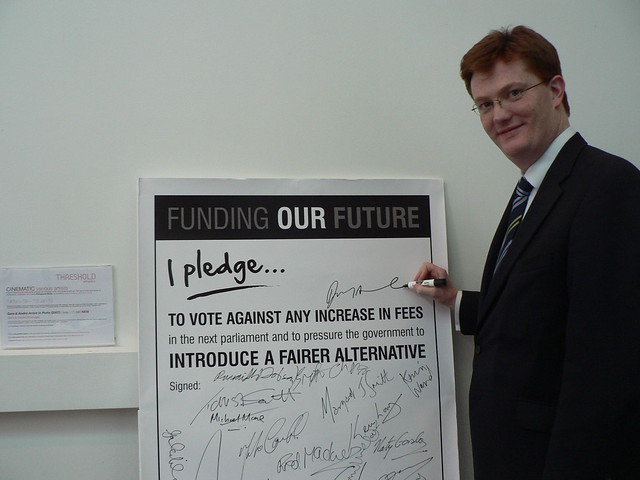
1.       Pledges are always good, aren’t they? We can remember previous Lib-Dem Pledges.  Like this one:

Lib Dem MP, Danny Alexander, signing a Pledge he and his party spectacularly broke


Why should we take this Lib-Dem Pledge seriously?

2.       You had an opportunity to get Devo Max onto the referendum ballot paper, but all three of you declined to back proposals.  What has concentrated your minds now?

3.       Never mind, you have got together now.  So, what stopped you getting your joint proposals into the Queen’s Speech? The Queen's Speech sets out the government’s agenda for the coming session, outlining proposed policies and legislation; two of you – the Tories and the Lib-Dems – are in the government.  Why were your proposed “extra powers” not in the Queen’s Speech?

4.       Could it be that you weren’t quite so worried then about losing the referendum?  That’s understandable. Oh, but, hold on, once we’ve voted No, you won’t be worried any more, will you?  How can we be sure you won’t forget your sudden joint enthusiasm?  (Don’t say “Pledge” again.  Remember, we’ve seen your Pledges before).

5.       And if you are so keen now on “extra powers”, isn’t that an admission that the UK doesn’t work very well as it stands?

6.       Even if we believe that you will deliver on this Pledge, will any of the “extra powers” get rid of nuclear weapons for us?

7.       Will any of the “extra powers” enable us to defend the Welfare State by giving Scotland power over all welfare, benefits and pensions?

8.       Will any of the “extra powers” enable us to renationalise the Royal Mail?

9.       Will any of the “extra powers” keep Scotland out of illegal wars?

10.   If “extra powers” are so great, why don’t we just go the whole hog and claim them all, rather than wait to see what we are given, if and when Westminster decides to grant them?


The fact is, we don’t really know what we’re being offered; we’d be voting for a pig in a poke.  And we don’t trust you to deliver anyway.  The only way we can be sure of getting powers that will make a difference to things we care about is to vote Yes on September 18th.