Thursday, 10 July 2014

Here's what Yes achieves; where does No get us?


It can be infuriating as well as exhilarating  to be part of this debate we're having.  But I'm never in any doubt what side I have to be on - just a look at who backs and funds the No campaign reaffirms that.

I've written elsewhere in this blog about what I think a Yes vote immediately achieves, or leads to us achieving. Useful things, too: defending the Welfare state, defending the NHS, getting rid of Trident, renationalising the mail service. And it delivers a shock to the status quo, both here and in the rest of the UK, providing working class people with the chance to upset the neoliberal consensus.

(See these posts for a fuller discussion:

- "Will it actually make any difference to us if Scotland becomes independent?"

- "We can defend the Welfare state: we can vote Yes". ).

That's what it achieves.  What it does not achieve is a fair society and a restructuring of democracy. We do not automatically get equal access to resources, participation and decision-making for all in our society.  On the 19th September, those inequalities will still be there.  On independence day, 24th March 2016, those inequalities will still be there. Food banks will still be needed, services will still be unequal, local democracy will still be distant and unresponsive, and so on and so on.

Some Yes campaigners talk as if voting Yes solves all that in itself. It doesn't.  Yes is not a panacea; it's an opportunity to start building a better Scotland.  It starts a process.

That doesn't make it not worth doing.  It's very much worth doing.  It's a great opportunity to break the neoliberal logjam; perhaps the only such opportunity we'll have in our lifetimes.  Certainly the only such opportunity available to us now.

You might think that's obvious, so why even bring it up? Well, some people have said to me that because a Yes vote doesn't automatically bring us a fair and equal society, it isn't worth bothering with, that it's therefore a distraction.  This is a purist position I can't agree with.  We have to take what's in front of us and see what we can do with it.

To those people I say: look at what we can do immediately, and look at what we have to chance to build towards. Does voting No achieve that?  Voting No doesn't even start a process.  If No wins, then we keep WMD, we continue down the road to losing the welfare state and the NHS, the Royal Mail stays in private hands, the neoliberal project marches on uninterrupted, and we keep the institutional rightward bias of Westminster. I say it in person when I meet them, and I try to reach them through social media, to open a dialogue with them.  I don't expect one tweet to change anyone's mind, but just tweeting to the converted definitely won't.

So, I'll continue to say it: these immediate gains are worth having, so let's take them. Then let us push further and take the rest. That's what Yes achieves. Where does No get us?

Monday, 16 June 2014

10 Questions for the Pro-Union Parties on the Pledge of "More Powers".

So, the Tories, Lib-Dems and Labour have got together to make a joint-pledge on “more powers” for Holyrood if we vote No.

Campaigners
Tories, Labour and Lib Dem leaders pledging "more powers".

We have some questions for you:

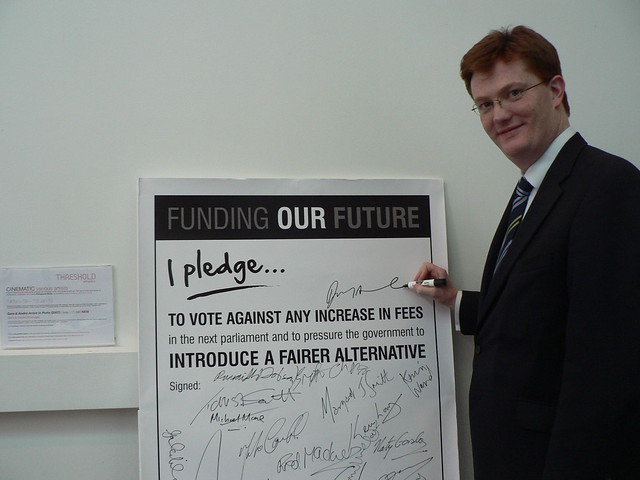
1.       Pledges are always good, aren’t they? We can remember previous Lib-Dem Pledges.  Like this one:

Lib Dem MP, Danny Alexander, signing a Pledge he and his party spectacularly broke


Why should we take this Lib-Dem Pledge seriously?

2.       You had an opportunity to get Devo Max onto the referendum ballot paper, but all three of you declined to back proposals.  What has concentrated your minds now?

3.       Never mind, you have got together now.  So, what stopped you getting your joint proposals into the Queen’s Speech? The Queen's Speech sets out the government’s agenda for the coming session, outlining proposed policies and legislation; two of you – the Tories and the Lib-Dems – are in the government.  Why were your proposed “extra powers” not in the Queen’s Speech?

4.       Could it be that you weren’t quite so worried then about losing the referendum?  That’s understandable. Oh, but, hold on, once we’ve voted No, you won’t be worried any more, will you?  How can we be sure you won’t forget your sudden joint enthusiasm?  (Don’t say “Pledge” again.  Remember, we’ve seen your Pledges before).

5.       And if you are so keen now on “extra powers”, isn’t that an admission that the UK doesn’t work very well as it stands?

6.       Even if we believe that you will deliver on this Pledge, will any of the “extra powers” get rid of nuclear weapons for us?

7.       Will any of the “extra powers” enable us to defend the Welfare State by giving Scotland power over all welfare, benefits and pensions?

8.       Will any of the “extra powers” enable us to renationalise the Royal Mail?

9.       Will any of the “extra powers” keep Scotland out of illegal wars?

10.   If “extra powers” are so great, why don’t we just go the whole hog and claim them all, rather than wait to see what we are given, if and when Westminster decides to grant them?


The fact is, we don’t really know what we’re being offered; we’d be voting for a pig in a poke.  And we don’t trust you to deliver anyway.  The only way we can be sure of getting powers that will make a difference to things we care about is to vote Yes on September 18th.  

Thursday, 12 June 2014

The Fringe Minority Who Damage Us All

Let me say upfront, the vast majority of debate in the referendum campaign – whether online or offline - has been good natured. Sometimes it has been heart-felt, sometimes robust, and sometimes tough questions are asked. But it has been, in the overwhelming majority, respectful and has maintained a remarkable level of decorum. It is possible to be passionate without rancour, and this debate and campaign has predominantly been just that.

Criticism does not equal abuse

Let me also say this: some people will always try to paint any criticism, critique, or questioning of their position, however respectfully addressed, as “abuse”. It’s a pity, but if you can review your argument with pride, there’s nothing to worry about.

However, there is a small minority on both sides of the debate who cross the line from passion into personal abuse. And there is an undeniable culture of misogyny in some of that abuse. This is not confined to the referendum campaign, nor is it confined to cyberspace, but it is something that women in public discourse are subjected to.

Twitter is the public sphere

And let us not be under any illusions: your postings on Twitter are public discourse. They are not a private chat with your mates in someone’s kitchen. They are public utterances, and they can and will be used to try and paint the campaign you espouse in a certain light. You need to remember that you represent a campaign; your conduct affects us all.

Misogyny 

So what am I talking about? Some people – a very few, but they exist – seem to think it’s OK to respond to women with whom they disagree by calling them a “bitch”, a “whore”, a “slut” or even a “cunt”. It is not OK. Not even a bit. It doesn’t matter that you call your male friends those things. It isn’t just “part of the knock-about nature of debate”. It denigrates women. It is unacceptable abuse. And it negates any valid point you may have had.

I have also seen comments about women’s appearance. Again on both sides – “she’s ugly”, “she’s fat”, and so on. It’s unacceptable, whoever it’s aimed at.

By using these terms, these themes, you are damaging all of us. You are letting down your side, whichever side that might be. So don’t do it.

If you are in any doubt as to whether your tweet might be construed as misogynist, don’t send it.

Nazi smears

Nor is it just misogyny. We don’t like it when people in the No camp liken the Yes campaign to Nazis. And this, incidentally, isn’t just at the fringes, but often comes from people right at the top of the No campaign. I saw tweets from Blair McDougall advertising James MacMillan’s ludicrous article which smeared Yes artists as like Nazis as a “must read”. We have heard the audio of Alistair Darling agreeing with a journalist’s description of the Yes side as “blood and soil” nationalists. He had the opportunity to disagree, but didn’t; he said that’s what they were “at heart”.

But how can we complain if some among us respond in like? If some among us use Nazi era terms like “Quisling”, or liken people to Goebbels, or deploy any hyperbole that allows them to paint us all as intolerant and extreme?

It doesn’t matter who started it. Which tweet do you think the press will pounce on?

Agent provocateurs 

And that brings us to another matter. How easy would it be for me to open a new Twitter account, badge-up with a Better Together Twibbon, and set out to discredit the No campaign? Extremely easy. Don’t you think the state has thought of that? We know that special branch and MI5 agents go under cover and infiltrate political movements. Look at the Mark Kennedy/Stone scandal. We know it happened during the miners’ strike, during the anti-poll tax movement. It would be remarkable if, during this time that the British state itself is under threat, they weren’t doing it now.

And the social media makes it much easier for agents to go under cover, and engage in agent provocateur activity.

No, not all of the fringe idiots flinging misogynist abuse are agent provocateurs, but let us be quite clear: the effect is the same. If you do it, you damage the whole movement, and you might as well be working for MI5.

Keep it positive 

The confines of 140 characters make it hard to make your point concisely; the ability to click and send without thinking, and the anonymity of the net makes it easier to issue abuse you wouldn’t use face to face. But that should be our rule – if you wouldn’t say it to someone’s face, don’t say it. I’m not talking about being squeaky clean prudes who never utter a word in anger. If you’d say “up yours” to George Osborne’s face on budget day when provoked by attacks on working class people, then of course you can say it on Twitter. I did. Just don’t stand by when others are besmirching the movement with their misogynist tirades.

Like the vast majority of us do, keep it positive, keep focussed on the issues, and remember that they’re going to use all the dirty tricks they can. Don’t fall into their traps.

Monday, 26 May 2014

“Will it actually make any difference to us if Scotland becomes independent?”

It’s a fair question, and one that I’d hope everyone asks before deciding how to cast their vote in the referendum:

“Will it actually make any difference to us if Scotland becomes independent?”

Well, will it?

My top reasons for voting Yes are here:


Let’s take those one at a time. First, defending the Welfare State. Can’t that be done through Westminster?

Not really. Westminster under the Tory/Lib-Dem coalition is dismantling the Welfare State, and rather than try to stop them, Labour is joining in. On Wednesday March 26th, Labour, the Party of Atlee and Bevan, voted in favour of the Tory Welfare Cap. Save the Children warned that the welfare cap will push 345,000 children into poverty over the next four years, but Labour voted in favour anyway.


What about the NHS? Hasn’t the NHS in Scotland always been separate? Isn’t it one of the current devolved powers?

Although the NHS in Scotland is devolved, there is a direct link between Westminster health spending and what’s available to Holyrood to spend on NHS Scotland.

As Westminster freezes or reduces public funding for the NHS in England, as less of the funding comes from the public purse, this would have a knock-on effect on Scotland's grant from Westminster, which the Barnett formula calculates as a percentage of public spending south of the Border.

Listen to Philippa Whitford, an NHS surgeon, explain why she is worried about the outcome of a No vote on the Scottish NHS:

“In five years England will not have an NHS as you understand it, and if we vote No, in ten years neither will we.”


See NHS for Yes: http://www.nhsforyes.org/

The Welfare State is an achievement to be cherished, but it is being undone. The Westminster arithmetic means that the parties chase a few swing constituencies, pulling the consensus rightward. (I discuss this more fully here: link) We have a chance to do things differently. We can build a social democratic consensus and defend the Welfare State.

What about nuclear weapons?


Scottish CND are backing a Yes vote.

They are quite clear that a Yes vote is the best way to get rid of Trident.


The vast majority of Scots oppose Trident. And look at the opposition to replacing Trident: 80% of people are opposed – including 87% of people planning to vote Yes in the independence referendum, and 75% of No voters.

Think of the things we could spend that money on if we were to vote against nuclear weapons!

See Scottish CND’s own site here: Link


If the SNP were to be the elected the first government in an independent Scotland, they have pledged to renationalise the Royal Mail. See this link

It’s likely, given the opposition to mail privatisation, that other parties would follow suit.

Never forget, austerity is an ideology, not a necessity. It is a choice that governments make, and it's the wrong choice. Miliband and Balls are committed to keeping the Tory austerity plans if they are elected to government in 2015.


If Scotland votes No, that will deliver a huge boost to the Tories. Labour are far from certain to win. But even if they do, they’ll keep austerity! Voting Yes gives us our best chance to rid ourselves of austerity.

The No campaign has been built on scare stories: telling us what we can’t do, what we shouldn’t do, and what we won’t be allowed to do. Perhaps you’ve seen the recent newspaper ads by the "Vote No Borders" campaign? (It's an organisation owned by Tory-supporting millionaires).

I’m not the most enthusiastic fan of the Wings Over Scotland site, but this is an excellent article taking each of those ads and examining the claims they make (where there are claims at all). Well worth a read. And a good summation of what we should be thinking about when we vote in September.


And let’s not forget the effect that I hope and believe independence would have for the rest of the UK.

I think it'd give Westminster a big shock to the system. It'd be weakened, and that's an ideal time for the working class to make demands. The Welfare State was won at a time when the state recognised that the demands of the people had to be acceded to. If the people of the rUK seize the moment, I think a similar realignment of the consensus is possible. Especially if looking north, the rUK sees WMD going, the mail service being renationalised, the NHS being defended from cuts, and so on.


Stop abusing the plebs and start to listen.

Those of you roundly abusing those who didn’t vote in the European elections as idiots and stooges with no right to complain, stop and think about this: they outnumber you vastly. You belong to a small minority who voted; two thirds of the electorate did not. They have sent the loudest message that representative democracy allows them to send, and still you are not listening.

Two thirds; think about that. If your preferred option in the independence referendum scored two thirds against the other side’s one third, would you accept that as a clear result? Of course you would. So why are you not listening to this clear result?

Before we go into what that loud message might be saying, think about this, too: what makes you so sure that had there been a full turnout they would have voted the way you wanted? If forced to chose, by compulsory voting legislation, they may have fallen into the same proportions we saw last night. It was a bigger sample than any professional poll, after all. What makes you think merely ensuring people turn out to vote would guarantee that people vote “correctly”?

Howard Zinn (an atheist, incidentally) once said sardonically: “If the gods had intended for people to vote, they would have given us candidates”. What did he mean?

Well, speak to people who don’t vote and ask them why not. They’ll tell you that they have a pretty low opinion of politicians, that they’re “all in it for themselves”, that it makes very little difference to their lives who wins. As the Who song says, “Welcome the new boss, same as the old boss”.

You don’t think so, because you are a political anorak. You are convinced that your tribe of politicians will be better than all those other tribes. The public aren’t so convinced. They have experienced politicians wearing different rosettes, and they haven’t been persuaded that any of them are representing their interests. They certainly aren’t convinced enough to make a trip to a polling station, not for a European election.

What can we legitimately say about reasons for low turnout at European elections? Well, let’s try. That people see the European parliament as remote? That people don’t really know what its role is or powers are; where it sits with what the European Commission does or what the Council of Ministers does? That they suspect that none of these distant bodies listens very much to what they have to say? (After all, you can even send BNP MEPs over there and what difference does it make?) That it’s just another bunch of people in offices somewhere making decisions about us without actually involving us? That they’re going to do what they do anyway, and it won’t be our interests they serve when they do it?

The turnout in the local elections south of the border was around the same as the European turnout. That suggests to me that people feel just as disconnected from local government; it feels just as distant as Strasbourg and Brussels. At the last council elections in Scotland, the turnout was similarly low - 39.1%. It was lower in Glasgow at 31.7% over the city, but even lower in some wards.

You are probably still shouting “well get out and vote to make a difference!” despite this huge majority telling you that they don’t think it does make a difference. Not even if they try to shock the political system by voting UKIP or BNP.

Some people try, it’s true. But it’s worth noting that even when returning UKIP top of the poll for the European parliament, people south of the border put them in fourth place for local government. “Look”, they seem to be saying, “We’re not stupid. We want to send you a message, but we don’t necessarily want these people running local services”.

“But”, you counter, “A protest vote is dangerous; it legitimises the party you lend your vote to, and makes them think all their views have some level of support”.

“Exactly”, the majority who didn’t vote might say. “We don’t want to legitimise any of them; a plague on all their houses”. They’re saying the opposite to what you said at the top of the page; they’re saying “If you voted, you’ve only got yourself to blame; you have no right to complain”.

You’re an adherent of one of those houses, though, so you’re unwilling to accept that. The idea that your tribe of politicians might be seen by the majority as in any way equivalent to these other tribes shocks you so much you can’t accept it. You’d rather see the non-voting majority as lazy, stupid, and racist-by-extension. And you think that attitude will win them over? Really? How’s that going for you?

Does telling people that they're stupid and that they just don't get it (but that you do) ever win them over?

Try listening for a change. Try and find out what people are saying. I think they’re saying “We feel powerless”. Is there anything you can do to change that? What can you do to contribute to their empowerment? Because more of the same isn’t an option.

Wednesday, 7 May 2014

The Inferiorisation of a Scottish Currency: the BBC and belittling the Pound Scots.

For time to time an article appears that shouts its subtext louder than its ostensible contents. Just such an article appeared today on the BBC News website.

It’s a piece about Prof. Gavin McCrone’s evidence to Holyrood today, giving his view that an independent Scotland should opt for a separate currency, pegged to Sterling, rather than Currency Union, as the Scottish Government prefers. So far so good, and I actually agree with McCrone on this. However, now look at the article. [Link].

The version I’m looking at is date and time stamped 7 May 2014 at 07:23.

The title of the piece is “How many unicorns do you earn?”, and below that is a large fantasy fiction style picture of the mythical beast.

After asking “How many unicorns would it take to do your weekly shopping?”, the piece begins: “This sounds like the start of a bad joke”.

The Unicorn was a gold coin used in Scotland for only 41 years, until 1525, and named for the Scottish heraldic symbol used on its obverse face. When Scotland joined the Union in 1707, the coin had been out of use for the best part of two centuries. Gavin McCrone has not suggested the Unicorn be re-introduced. Nobody has. So why bring it up? Why name an article on a modern Scots currency “How many unicorns do you earn?”, and why illustrate the piece with a large picture of the beast? (Why, if mentioning it at all, not depict the coin?)

The article was trailed on Twitter with the words: “Unicorn, groat, penny and merk. Could Scots currency make a come-back?” And again the mythical beast was pictured.


I have covered before on this blog the practise of calling a Scots currency “Groats”. Scotland’s currency was never “Groats”. When last used in Scotland, Groats were in fact a Sterling coin. Last minted in the UK in 1856, Groats were worth four pence. They were used until withdrawn in the 1880s. They were never the name of the currency north or south of the Border. Why would Scotland call its currency “the fourpence”?

Prior to Union there was also Scots coin called the Groat, and there were variations of the name in coinage throughout Europe - The Dutch Groot, the Tyrol Groschen etc. It was a term for a thick coin, derived from the Latin adjective meaning thick or heavy, grosso. It is an antiquated coin type, once common across Europe.

People pretend they think a Scots currency would be called the Groat to belittle and ridicule the idea, and make the notion of a Scottish economy seem antiquated and obsolete. It's just a cheap shot by people who want to suggest an independent Scotland would be backwards, and a Scottish currency crude and naive.

The Unicorn was introduced to the story not by McCrone, but by BBC reporter Jamie Ross. The imagery is clear enough: the idea of having our own currency is a fantasy, and – as the opening remark tells us – “a bad joke”. This is all very familiar to those who have read Frantz Fanon; Jamie Ross is telling us that once left to our own devices by our Westminster saviours, Scotland “would at once fall back into barbarism, degradation and bestiality” (p169, Fanon, 1967, "The Wretched of the Earth"). Is he doing it on purpose? Possibly, but more likely he just knew what sort of thing would go down well: a jokey, fatuous, and patronising piece. The sort of thing no BBC reporter would ever turn in on Sterling.

Groat, Angel, Double Leopard, and Mark are all old English (and/or British) coins, of varying vintages. No BBC piece on modern Sterling would ever use up space discussing those, or illustrating the piece with pictures of angels from mythology (rather than the coin). Such an article would never get anywhere near the BBC website. But for Scottish stories, that sort of thing is exactly what is wanted. The patronising and cringe-inducing defence policy animation is another case in point.

McCrone has long advised a separate currency for an independent Scotland. He does so in his recent book “Scottish Independence: Weighing Up the Economics” (2013). It’s well worth a read. And he was quoted by the Scotsman as having favoured “the restoration of the pre-1707 pound Scots, or indeed the Merk, and it could be pegged against Sterling initially on a one-to-one basis as Ireland’s currency was.”

Why mention Merks? A merk was a Scottish silver coin, worth ⅔ of a Pound Scots. It wasn’t the name of the currency (that was Pound Scots). Perhaps McCrone was searching for a good Scots word to name the new currency, and it’s the same name the Germans used for their currency until joining the euro, after all. However he needn’t have bothered; there’s already a guid Scots word for Pound: Pund. McCrone’s slight linguistic diversion, though, is as nothing compared to the patronising flight of fancy that the BBC News website goes on. And not for the first time.

Friday, 25 April 2014

25 Questions for the BBC on its CBI Membership

So, in a joint statement the BBC has announced it is to “suspend” its membership of the CBI due to the CBI’s status as an official “No” campaign. There are still many questions that the BBC needs to answer. I have 25 that I think urgently need to be answered. Perhaps you can think of more.

1. Why did it take so long for the BBC to act, given that it had been reporting for a week on other organisations leaving the CBI to maintain neutrality?

2. When did the BBC first become aware of the CBI’s stance as being opposed to independence?

3. During the time the BBC was aware of the CBI’s stance, how many times did it quote the CBI on the issue of independence?

4. Why did the BBC never declare its interest while reporting the CBI’s views on independence?

5. What are the terms of the “suspension” from the CBI?

6. Why is the BBC an unsuspended member until the 30th May?

7. How can it report impartially on the referendum while still an unsuspended member?

8. What does the BBC pay the CBI for membership per year? How are those payments split?

9. Was the BBC aware that it was funding partisan campaigning by making those payments?

10. Is the BBC aware of the anti-independence materials the CBI has already prepared and publicised, for example their current website materials?

11. Are these appropriate materials for the BBC to fund with our licence fees?

12. How long has the BBC been a member of CBI?

13. Why is the BBC a member of the CBI?

14. Was the BBC a member of the CBI while it reported on issues the CBI has campaigned or lobbied on?

15. Was the BBC a member of the CBI when the BBC has reported on issue of occupational pensions? Or when the CBI has been quoted by the BBC on the issue of occupational pensions?

16. Was the BBC a member of the CBI when the BBC has reported on or the CBI has been quoted by the BBC on taxation? On executive pay? On public services? On immigration policy? On employment law? On the economy? On any of the issues that the CBI campaigns or lobbies on?

17. Was the BBC a member of the CBI during any industrial dispute in which it has sought quotes from CBI figures?

18. Was the BBC a member of the CBI during the miners’ strike?

19. Was the BBC a member of the CBI on 18th June 1984, when the BBC was editing and compiling footage for a report on the events at Orgreave?

20. Where does the BBC publish and publicise its membership of the CBI?

21. Is that information given due prominence?

22. How long has that information been made public?

23. Did the BBC reporters seeking answers from the CBI about membership figures know where to find information about the BBC’s membership?

24. When the BBC resumes membership of the CBI on September 19th, how can it be sure its impartiality on the post referendum landscape will not be tainted by membership of an organisation which will have views on that landscape, whatever it is?

25. How will the BBC rebuild trust in its integrity?


If the BBC is not promptly and comprehensively open about these issues, then it will become mired in doubt and confusion, and will itself continue to be the story.